Captain America – Drug War
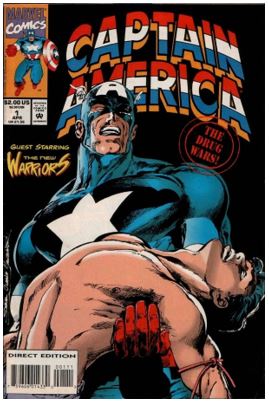
Author: : Peter David and George Caragonne (writers), Sal Velluto and Colleen Doran (pencillers), Keith Williams and Greg Adams (inkers), and Bob Sharen and George Roussos (colorists)
Format: Comic Books
Pages: 48
Publish Date: April 1994
Publisher: Marvel Comics
Author website: https://www.marvel.com/comics/creators/121/peter_david
Additional info: https://www.marvel.com/comics/creators/2381/george_caragonne
Review
by Matt Peters
In World War II, it was common for soldiers to take government-issued amphetamines to help stay alert and confident in hostile situations. In fact, U.S. troops consumed an estimated 250 to 500 million amphetamine tablets over the course of the war. Cigarettes were also ubiquitous, and they were included in many military rations. Versatile in their effects, cigarettes could relieve boredom during periods of calm and stress during periods of combat.
Although Timely Comics (later known as Marvel) created Captain America to be a symbol of virtue, even he enjoyed a bit of tobacco during World War II. In Captain America Comics #1 (1941), Steve Rogers is shown smoking a pipe in two of the comic’s scenes (page 13, panel 2, and page 25, panel 5). In both instances, he’s in plain garb rather than his Captain America costume, suggesting that he (or his writers) had a hunch that it would be okay for a regular guy to puff on a pipe but a bit out of character for Captain America. On the other hand, Cap owed his status as a superhero to the physically altering Super-Soldier Serum he took when he signed up to be a WWII-era military science experiment. Thus, while some non-therapeutic drug use was out of character for him, other use was part and parcel to his identity.
That background, one might hope, would prepare Cap to have a nuanced understanding of recreational drugs. One might also hope that it would prepare him to understand—intuitively, if not academically—why the simplistic scaremongering and abstinence messaging of “Just Say No,” D.A.R.E., and similar anti-drug campaigns from the 1980s and 1990s failed to keep kids away from regulated and controlled substances (for reasons that will be explored in more detail later in this review).
Unfortunately, that kind of nuanced understanding of the issue was largely absent when Cap became the main character in a cautionary tale about addiction. In the 1990s, Marvel partnered with the Federal Bureau of Investigation to produce a free, two-issue limited series, Captain America Goes to War Against Drugs. The first issue was released in 1991 and the second in 1994. Both comics were later reprinted together, this time with a cover price of $2.00, in Captain America: Drug War (1994).
The cover design for the Captain America: Drug War would suggest that the subtitle is actually The Drug Wars—plural and with a definite article. That phrase appears in red text, with a circular outline, right below the title text. But the comic’s first-page indicia show that the subtitle is, in fact, Drug War. That mismatch portends the many strange creative decisions throughout the comic.
The comic is divided into two parts, owing to its origin as a two-issue series. The first part, “High Heat,” is written by Peter David. In it, David introduces an alien race called the Tzin who have a long history of plundering planets around the cosmos. Their next target is Earth, and they want to see if mass intoxication would subdue human resistance to their conquest. They thus decide to see if their own Tzin-made drugs would be enough to dull the senses and weaken the will of humankind.
Consciously or not, David appears to be taking a cue from history in setting up this plot. Scholars of colonialism and genocide have noted how alcohol and other intoxicants have been used to placate populations that might otherwise be focused on political independence, territorial sovereignty, or economic self-determination. During talks that eventually led to the UN Genocide Convention, Polish lawyer Raphael Lemkin noted how the Japanese government “imposed mass consumption of drugs in order to disintegrate the minds of the Chinese population…and make them forget their national aspirations and their craving for national freedom.” In Lemkin’s own nation of Poland, Nazi occupiers tried to undermine society by encouraging drinking among the working class. Earlier in history, alcohol had been used in similar ways in the conquests of Tasmania and North America.
David, though, doesn’t do much with this plot setup, so any historical allegory that’s there is quickly put aside for more predictable storytelling about the dangers of recreational drugs. Rather, the introduction of the Tzin and their drug-pushing ways seems to be David’s way of making the story more broadly relevant—that is, by introducing a fictional drug with ambiguous effects, thereby crafting a story that could apply to heroin just as easily as it could apply to cocaine, ecstasy, or any other street drug. Of course, by creating this fill-in-the-blank drug, David also sacrifices some real-world relevance at the same time.
As the story opens, the Tzin are starting with a small pilot study before they intoxicate the planet at scale. “I shall select four young people from a cross section of humanity,” says an unnamed member of the Tzin. “We shall see whether they can be swayed into self-destruction. If half of them are, that will be enough to prove that mankind’s resolve is not that strong, and humanity can be overcome” (page 6, panels 3 and 5). The scientific rigor of such a pilot study is debatable, but it lets the story focus more closely on a small subset of humankind, starting with a high school athlete named Mitch Baskin.
Mitch is a talented baseball pitcher who’s struggling under the pressure to maintain his star status on the field. His emotional distress makes him receptive to the cunning and persuasion of a mysterious drug dealer named Harry, who’s really a member of the Tzin in human disguise. Harry convinces Mitch to take some of the aforementioned ambiguous drugs, and from there, Mitch’s life goes into a predictable downward spiral.
Captain America, meanwhile, has an equally predictable role as the person who helps Mitch pick up the pieces and get his life back on track. Another one of the comic’s strange creative decisions was to have Cap intervene in Mitch’s personal crisis even before Cap or any other human character knew that a hostile alien race was involved. It was apparently a slow day for superheroes when Cap decided to take a stab at being a substance abuse counselor.
To his credit, Cap doesn’t act very judgmental toward Mitch, but what he does say tends to repeat common tropes in anti-drug messaging of that era. “Drugs just destroy the gift you have,” says Cap (page 19, panel 5), even though Cap himself is a guy who got shredded on Super-Soldier Serum and used to smoke tobacco. He reassures Mitch that everyone has bad days and that Mitch’s friends still care about him. It’s a good pep talk, but it barely scratches the surface of the emotional struggle that first led Mitch to seek a chemical escape.
After Cap and Mitch part ways, Cap walks down the same stretch of street where Mitch last encountered Harry, the drug dealer from earlier in the story. Cap notices something strange on the ground—something Harry has left behind. It ends up being the piece of evidence that helps Cap realize that there was a much bigger story behind Mitch’s earlier drift into the world of illicit drugs—a clue that the traffickers behind those drugs were not from Earth. Part one ends on that cliffhanger, and by the time part two begins, readers are left to assume that Cap has uncovered much more of the Tzin plot. But exactly how he did this detective work is left to the reader’s imagination.
Part two, “Drug Lords,” written by George Caragonne, essentially repeats the same themes as part one. This time the at-risk teen is a dancer named Dorreen. Like Mitch, Dorreen has developed a drug problem to cope with the pressure to be a top performer—and she, too, is hooked on Tzin drugs.
To add something new to the story, Caragonne has Cap team up with the teen superhero team the New Warriors. Caragonne also introduces a four-member squad of humanoid enforcers who work for the Tzin. Subtlety is nowhere to be found in the humanoids’ characterization. They have the code names Crack, Weed, Ice, and Ms. Fix, and each has a set of superpowers to match their code name. For example, Weed can make people cough and feel disoriented.
The Tzin are angry that Cap managed to put one of their would-be addicts, Mitch Baskin, back on a sober path. Now they’re working on getting Dorreen hooked to their dope, so they send the four humanoids to make sure Cap doesn’t get in their way.
Adding more super-powered characters was a way to dial up the action sequences, but they add little else to the story. The one exception is Janelle Chord. Also known as Silhouette, Chord is a member of the New Warriors who can use shadows as interdimensional portals. Chord’s importance to the second half of the comic is twofold. She takes Cap’s place as the person who reaches out to the at-risk teen. She also uses her dimension-hopping ability to get herself and Cap onto a Tzin ship to confront the alien drug lords. That confrontation leads to a series of events that convinces the Tzin to nix their plans for planet Earth—before they were even half finished with their pilot study.
Although Chord gets to take over as substance abuse counselor in part two, the change doesn’t help the messaging any. In fact, her dialogue is even worse than Cap’s, relying on tired platitudes and unqualified generalizations—and even some scolding. When Chord first discovers that Dorreen is abusing drugs, Chord exclaims, “What are you doing? Have you lost your mind?” (page 36, panel 4).
Chord takes a softer tack later in the story, but only after Dorreen has fallen into the pits of shame and hopelessness. “Is it too late for me to change?” asks Dorreen, her eyes downcast. “I want to give up drugs, but it’s so hard” (page 47, panel 4). Offering reassurance, Chord gives Dorreen a hug and says, “You’ve already done the hardest part, Dorrie—asking for help” (page 47, panel 5).
The heavy-handed dialogue and clichéd depictions of substance abuse in Captain America: Drug War ultimately do a disservice to the comic’s intended purpose. Numerous studies have found that exaggeration and scaremongering about the dangers of drugs are often met with skepticism by teen audiences. As soon as trust in the messenger is lost, so is the message, which is why fear-based campaigns like “Just Say No” and D.A.R.E. were essentially useless at preventing alcohol, tobacco, and illicit drug use among school-aged youths.
Many of those youths understand, at least anecdotally, that plenty of people use regulated and controlled substances without derailing their lives. Those users don’t end up in jails, hospitals, homeless encampments, or cemeteries. In fact, they uphold work and family responsibilities without incident. For some of those people, their habits do turn into addictions. However, most addicts simply age out of their condition and require no intervention, in large part because maturity tends to give them better impulse control.
For addicts who do need help, the kind of storytelling and messaging in Captain America: Drug War can often deter them from seeking that help. When substance abuse disorder is attributed to bad judgment or moral failure, it puts a heavy stigma on the condition. That stigma can isolate substance abusers and make them too afraid or ashamed to get help. As such, it was a missed opportunity that David and Caragonne didn’t make better use of the Tzin plot to weaponize addiction. It could have offered a way to explore substance abuse in a less individualized way—one that instead interrogates the role that political, social, and economic forces play in driving people into an underworld of illicit drug use.
In addition, David and Caragonne could have removed some stigma from Mitch and Dorreen by further exploring their reasons for becoming substance abusers. Both characters were coping with the pressure to excel in their extracurricular activities. It was an opportunity to interrogate the potential pitfalls of raising children in a competitive culture—and an opportunity to shift some of the blame onto success-obsessed parents and mentors.
To be fair to David and Caragonne, it could be argued that they were writing Captain America: Drug War at a time when the jury was still out about effective messaging for substance abuse prevention. One of the best meta-analyses about the effectiveness (or ineffectiveness) of D.A.R.E.-style messaging wasn’t published until 1994. The authors of that study found that “DARE’s core curriculum effect on drug use…is slight and, except for tobacco use, is not statistically significant.”
Future comics like Captain America: Drug War could benefit from what developmental psychologists, public health professionals, and other experts have learned since then. Adolescents benefit from substance abuse education that is honest, not alarmist, about the health effects of regulated and controlled substances. They can also benefit from information about peer pressure and other social influences that can lead to substance abuse. They need messaging that doesn’t normalize vaping, opioid use, or other drug behavior but does take into account that some of them will make those choices. For those who try recreational drugs, they need practical information that can help them minimize harm—and find help, if needed, when they’re ready to quit.
As science and society evolve in their understanding of the causes and consequences of substance abuse, so should the stories that broach those topics. Captain America: Drug War is an example of where we’ve been in that understanding. Future comics, we can hope, will better reflect what we know now and continue to learn.
Reviewer’s Note: Pages in this comic book are unnumbered, so page numbers cited above are based on a manual count, using the indicia page as page one. Ad pages are included in the count.
Matt Peters is a program manager at the University of Arizona College of Health Sciences. He is a longtime Marvel fan with an interest in health communication and graphic medicine. Views expressed are his own.
Leave a Comment